XOVOX, the leader in voice recording extraction and data migration, can now extract audio recordings and metadata from the Genesys PureConnect platform. With this new capability, XOVOX can help companies move their voice recording data from Genesys PureConnect systems into a new recorder or cloud-based archive. Data can be retrieved from both live and discontinued systems.
Once extracted, XOVOX can convert the voice recordings and associated metadata into accessible formats and systems for a variety of purposes, including:
1) Import into a new recording platform or audio archive. This is particularly important when you are dealing with an “End of Life” situation where your recording platform has been discontinued.
2) Upload to cloud storage for compliance, retention, and regulation statutes, e.g. GDPR, SEC 17a-4, MiFID
3) Speech analytics and artificial intelligence – Use your voice data to train your AI so you can deliver better products and services as well as generate business insights to improve customer service and support and enhance your marketing initiatives.
Genesys PureConnect joins the extensive list of recorder formats that XOVOX supports, including call recording platforms like NICE 8.9, Verint, Eyretel Mediastore, VPI Empower, Racal/Thales/NICE Wordnet, Dictaphone Freedom, and many others.
“Adding Genesys PureConnect to our roster of 40+ known recorder formats is another example of our quickly responding to the evolving needs of our customers,” said Andrew Stevens, President of XOVOX. “This latest addition enhances our leadership position in the field.”
Companies generate troves of voice data that are filled with business insights, but these are typically locked away in proprietary formats within the systems that recorded it.
This CDOTrends article, “Your Customer Rant Will Fuel Tomorrow’s AI“, highlights the impact a company’s own voice data can have on their emerging AI initiatives. Stevens describes the potential for how AI trained on actual voice interactions of many kinds can be leveraged for better business and customer outcomes, and then outlines his vision for how voice data will have transformative implications far beyond the uses and expectations of today.
In enterprise environments such as call centers, voice recorder technology plays a critical role in ensuring regulatory compliance, maintaining service quality, and protecting both the business and the customer. Unlike consumer voice recorders designed for personal use, enterprise-grade systems — commonly referred to as voice loggers — are robust platforms engineered for scalability, reliability, and legal accountability.
What Is Voice Logging
Voice logging refers to the recording of telephone and other audio communications to create an indisputable, time-stamped record of conversations. This includes not just the spoken words, but also metadata such as the date, time, duration of calls, involved parties, and even dialed digits. Such records are invaluable for:
Regulatory compliance (e.g., PCI-DSS, MiFID II, HIPAA)
Quality assurance and agent training
Dispute resolution and legal evidence
Public safety and emergency response audit trails
How Enterprise Voice Loggers Work
How Enterprise Voice Loggers Work
A voice logger is an integrated system that captures and stores both audio and metadata associated with each call. These systems may be implemented as physical hardware within a data center or as cloud-based services, and can interface with PBX trunk lines, VoIP systems, or open microphones.
Key components include:
Audio capture: Intercepts calls in real time via telephone lines, VoIP streams, or other input channels.
Metadata collection: Gathers information like phone numbers, agent IDs, and call durations.
Accurate timestamping: Ensures legal validity and auditability.
Storage systems: Archive recordings securely, often with encryption and retention controls.
Databases: Store and index call metadata for fast retrieval.
Speech analytics (optional): Identifies keywords, sentiment, and compliance triggers.
Advanced features may include silence detection, voice-activated recording, and DTMF tone recognition.
Deployment and Scalability
Voice loggers are typically configured to support a specific number of “seats” (i.e., call center agents) or “channels” (simultaneous call recordings). Scalability is essential, especially in dynamic environments like contact centers where workforce sizes can vary seasonally or with business growth.
Deployment options include:
On-premise systems for tighter security and control
Cloud-based platforms for flexibility and remote accessibility
Hybrid models that combine both for optimized performance and compliance
Applications in Call Centers
In call center operations, voice recorders are not just compliance tools; they are strategic assets. Common use cases include:
Monitoring and training: Supervisors can review calls to provide feedback and coaching
Service quality improvement: Calls are analyzed for adherence to scripts and handling procedures
Legal protection: Recorded interactions can be used to resolve customer disputes or defend against claims
Regulatory audits: Secure archives ensure readiness for inspections or legal inquiries
Leading Voice Logger Providers
Over the past 35 years, many companies have contributed to the evolution of enterprise voice logging. Notable vendors include:
These platforms continue to innovate by integrating AI, real-time analytics, and secure cloud storage to meet evolving regulatory and operational needs.
Conclusion
Voice recorder technology in enterprise call centers is far more than a tool for capturing sound—it’s a mission-critical component of compliance, security, and customer service excellence. As regulations grow more stringent and customer expectations rise, investing in a robust voice logging infrastructure has become a necessity for any enterprise aiming to stay compliant and competitive.
In this landscape, XOVOX is uniquely positioned to convert legacy and proprietary recordings into modern, open formats that ensure secure, efficient, and standards-based access to critical communications.
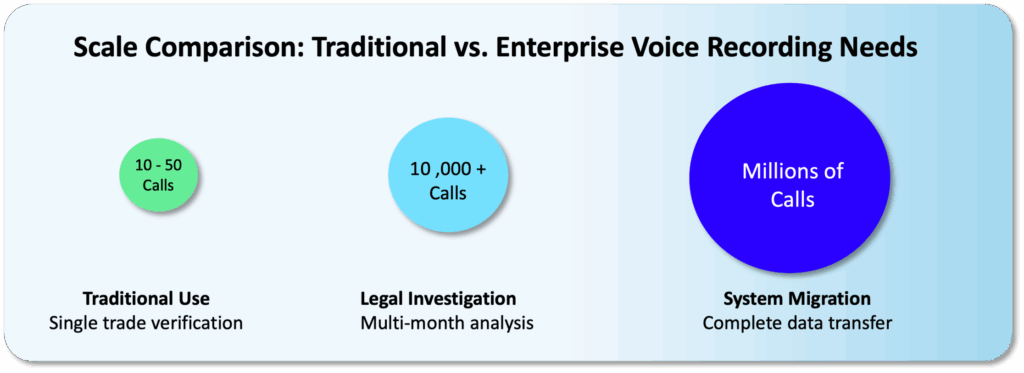
Modern organizations generate vast amounts of voice data daily through their customer communication systems. While traditional voice logging systems excel at capturing and storing individual conversations, they often struggle when faced with the challenge of bulk data retrieval. Being able to retrieve voice data at scale becomes a critical business issue when satisfying broad legal discovery requests, seeking to feed voice data into a conversational analytics engines, or undertaking voice recorder migration projects.
The limitations inherent in the native voice retrieval from logging systems can create significant operational bottlenecks, compromise compliance, and diminish the business value of your voice data recordings.
The Bulk Export Challenge
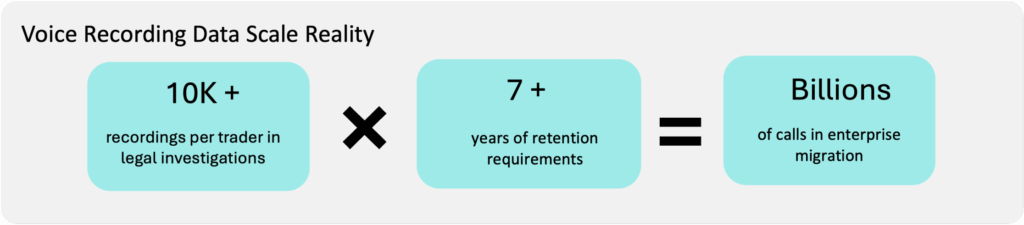
Traditional voice logging systems were designed with individual call retrieval in mind. They perform admirably when users need to access a few dozen recordings to clarify details around a specific stock trade or review a particular customer interaction. However, this approach becomes inadequate when organizations require access to thousands or millions of recordings simultaneously.
The fundamental limitation of bulk data export lies in the architecture of most voice logging platforms. These systems typically provide user interfaces optimized for single-call playback and small-batch exports. When faced with large-scale data requirements, users must resort to repetitive manual processes or rely on limited API functionality that may not even be available on their particular platform.
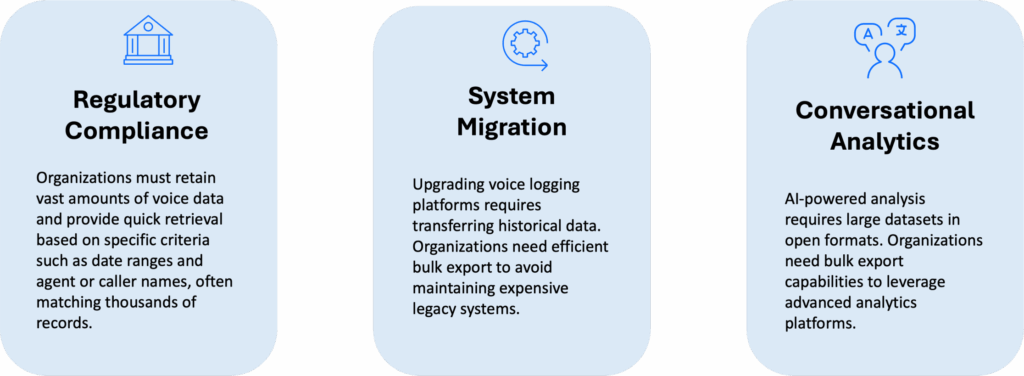
Three Critical Use Cases for Bulk Export Compliance
Technical Requirements for Enterprise-Scale Export
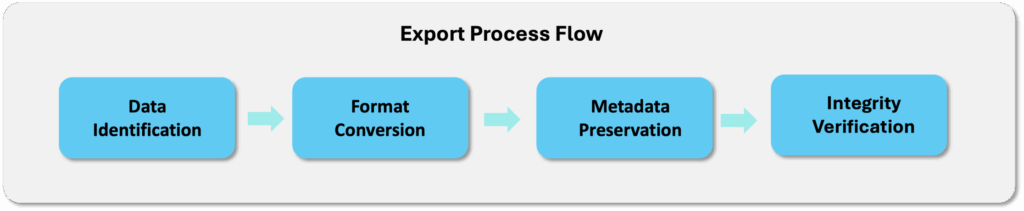
Successful bulk export operations require careful consideration of several technical factors. The exported data must maintain its integrity and authenticity, particularly for legal applications where recordings may serve as court evidence. This requirement demands robust metadata preservation, including timestamps, participant information, and chain-of-custody documentation.
Format standardization presents another critical challenge. While individual voice logging systems may use proprietary formats optimized for their specific platforms, bulk exports typically require conversion to industry-standard formats that can be consumed by various analytics platforms and legal systems.
Looking Forward: Solutions and Strategies
Organizations facing bulk export challenges have several strategic options to consider. Some may choose to negotiate with their current voice logging vendor for enhanced export capabilities, though this approach often involves significant additional licensing costs and professional services fees. Others may invest in third-party tools specifically designed to extract data from proprietary voice logging formats.
The most forward-thinking organizations are beginning to factor bulk export capabilities into their voice logging procurement decisions. By selecting platforms that prioritize data portability and open standards, these organizations position themselves for greater flexibility in future technology decisions while ensuring compliance with evolving regulatory requirements.
As the volume and value of voice data continue to grow, the ability to efficiently manage and analyze this information at scale becomes a competitive differentiator. Organizations that master bulk voice data management will be better positioned to leverage advanced analytics, ensure regulatory compliance, and make informed decisions based on comprehensive historical records.
When large volumes of call recordings are locked away in aging or proprietary voice logging systems, organizations face a difficult mix of technical risk, operational disruption, and tight project timelines. Traditional extraction methods are often slow, manual, and constrained by legacy hardware and software, making them poorly suited for bulk migrations or regulatory retention projects.
This guide introduces the XOVOX 10-step direct extraction process, a structured approach for retrieving audio and metadata directly from underlying storage media instead of relying on the original recorder interfaces. By combining modern infrastructure, format-aware processing, and rigorous reconciliation, the process is designed to handle millions of recordings efficiently while preserving evidential integrity and auditability.
The following sections explain the main extraction options available, outline why direct media extraction is recommended for large-scale projects, and walk through each of the 10 steps from initial inventory to final delivery of import-ready files. The goal is to give project teams a clear, repeatable roadmap they can use to plan, execute, and validate complex voice recorder data migrations with confidence.
Four Main Extraction Methods
1. Original Logger Equipment
How it works: Use the original recording system’s built-in playback features
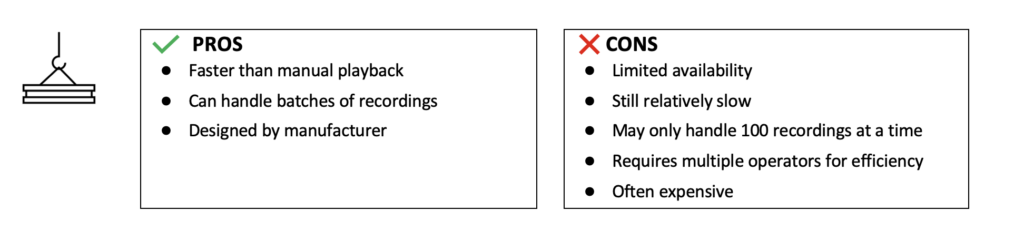
2. Bulk Retrieval Tools
How it works: Use manufacturer-provided software for batch download
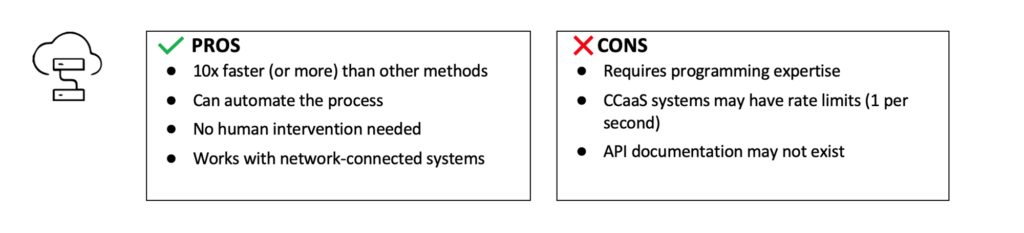
3. Custom API Tools
How it works: Write custom software to communicate with the logging system
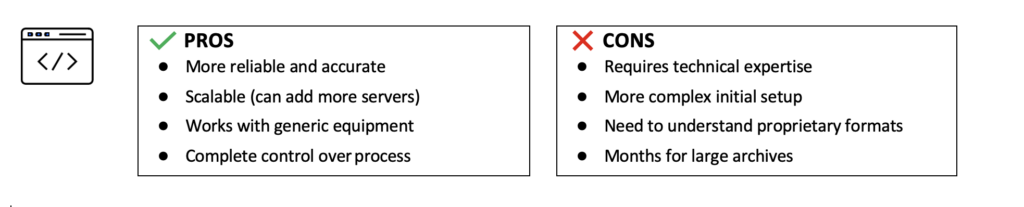
4. Direct Media Extraction ⭐ Recommended
How it works: Extract audio files directly from storage media without using original equipment or original software
The XOVOX 10-Step Direct Extraction Process
XOVOX has productized Method #4, the direct media extraction approach. Through two decades of performing these projects across hundreds of organizations, we’ve refined and optimized the tools and process to its current form. The following 10-step guide provides a structured and tested approach that XOVOX uses for successfully executing voice recorder data extraction at any scale.
Deploy Computing Environment: Set up Linux servers (physical or virtual). Configure secure access (VPN). Install fast disk storage.
Inventory the Archive: List all stored files, tapes, or DVDs. Export database tables if available. Document the full scope of data.
Fetch Source Data: Copy all archive files locally. Create byte-for-byte images of tapes/DVDs. Identify any damaged or blank media.
Extract Basic Metadata: Pull information embedded in raw data. Create individual call records. Gather timestamps, channel numbers, etc.
Convert Audio Formats: Transcode from nonstandard compression algorithms. Convert to open file formats (like WAV). Ensure compatibility with target systems.
Extract Extended Metadata: Pull additional information from databases. Match metadata to audio files. Include agent names, phone numbers, etc.
Format Metadata: Convert to required formats (CSV, XML, JSON). Prepare for import into target system.
Reconcile and Verify: Confirm all recordings were extracted. Account for any missing files. Document exceptions and reasons.
Deliver Final Results: Transfer to target location. Verify successful delivery. Provide import-ready files.
Special Considerations
In addition to the core 10 steps, there are several special considerations that can significantly affect planning, timelines, and execution strategy for complex or active environments.
Active Systems
For systems still in use:
Extract 95% of historical data first
Perform final 5% extraction after shutdown
Or set up daily/hourly extraction for ongoing operations
Large-Scale Projects
Steps can be performed in parallel
Additional servers can be added to speed up completion
Copying millions of files may take weeks
Verification is critical for wholesale deliveries
Why Direct Extraction Works Best
The direct extraction method bypasses the limitations of original logging systems by:
Working with raw data instead of through slow interfaces
Using modern, fast hardware for processing
Allowing parallel processing across multiple servers
Eliminating human error from manual processes
Providing complete control over the extraction process
This approach has proven to be the most reliable and efficient method for large-scale voice recorder data migrations.